

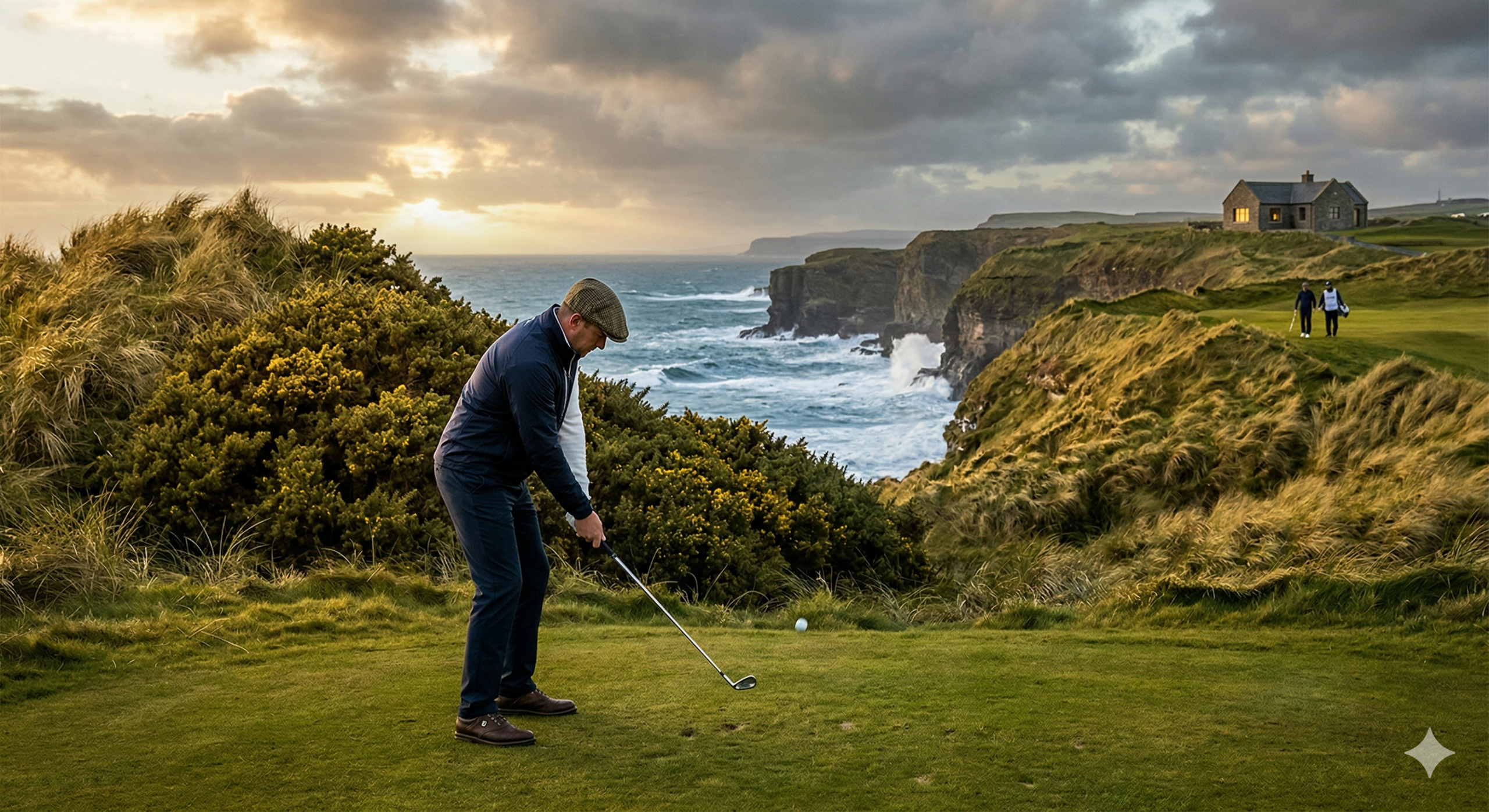
Yesterday, we walked the hallowed turf of St Andrews. Today, we cross the Irish Sea to face a different beast. The Irish coast—from the towering dunes of Ballyliffin to the rugged elegance of Royal County Down—demands a brand of golf that is as much about imagination as it is about mechanics.
On the Emerald Isle, the “perfect” high draw is often your worst enemy. To thrive here, you must trade the aerial attack for a ground-based strategy. Welcome to the Traveler’s Toolkit: your guide to mastering the links.
1. The Flight Control: Piercing the Atlantic Gale
In Ireland, “breeze” is a relative term. When the Atlantic wind whips across the dunes, your primary goal is to minimize time in the air. The higher the ball goes, the more the wind “grabs” it, exaggerating every slice or hook.
- The Technique: Take two more clubs than the yardage suggests (e.g., a 5-iron instead of a 7-iron). Choke down an inch on the grip and place the ball one ball-width back in your stance.
- The Swing: Think “Three-Quarter to Three-Quarter.” A shorter, controlled backswing and a low, sawed-off finish will keep the spin rate down. If you swing hard into a headwind, the ball will “balloon” and fall well short of your target.
- The Mantra: When it’s breezy, swing easy.
2. The Weapon of Choice: The Bump-and-Run
The tight, fescue fairways of the Irish links are often firmer than the greens themselves. Using a 60-degree wedge from a tight lie is an invitation for a “thin” shot into a gorse bush.
- The Play: Reach for an 8-iron or even a hybrid from 30 yards out.
- The Execution: Use a putting stroke. Keep your weight on your lead foot and your hands slightly ahead of the ball. The goal is to get the ball on the ground as quickly as possible and let the natural contours of the land do the work.
- The Benefit: A bad bump-and-run usually ends up 15 feet away; a bad flop shot ends up in the next county.
3. Putting in a Gale
When the wind is strong enough to move your ball on the green, your standard upright stance is a liability.
- The Adjustment: Widen your stance significantly to create a stable “tripod” base. This prevents the wind from rocking your body during the stroke.
- The Read: Remember that wind affects putts more than you think—especially on the lightning-fast greens of Portmush or Lahinch. A crosswind can easily “hold up” a breaking putt or exaggerate it.
Essential Gear: The Traveller’s Launch Monitor
How do you know if you’re actually lowering your spin rate? You need data, but you can’t lug a full-sized simulator across Ireland.
The Recommendation: FlightScope Mevo
The FlightScope Mevo is the size of a deck of cards, making it the ultimate travel companion for the Global Golfer.
- Why it works for travel: It fits in your pocket and provides essential data like ball speed and carry distance—perfect for calibrating your “links clubs” on the range before you head to the first tee.
- Affiliate Link: [Shop FlightScope Mevo at American Golf / PGA Tour Superstore]
The Recovery: Post-Round Revival
After 18 holes of fighting the elements at Old Head, your lower back and forearms will feel the strain of those abbreviated “punch” shots.
- The Routine: Use a percussive therapy device to flush out lactic acid and keep the joints mobile for the next day’s 36-hole marathon.
- The Recommendation: The Theragun Mini. It’s compact enough for your carry-on and powerful enough to reset your muscles for tomorrow’s round.
- Affiliate Link: [Shop Therabody via Mr & Mrs Smith / Amazon]
Conclusion
Ireland doesn’t ask you to play better golf; it asks you to play smarter golf. By embracing the ground game and respecting the wind, you stop fighting the landscape and start dancing with it.
Disclosure: Some links may be affiliate links. The Global Golfer may earn a commission at no extra cost to you.