

County Clare · Ireland · Home of the Blind Par 5
Lahinch Old Course
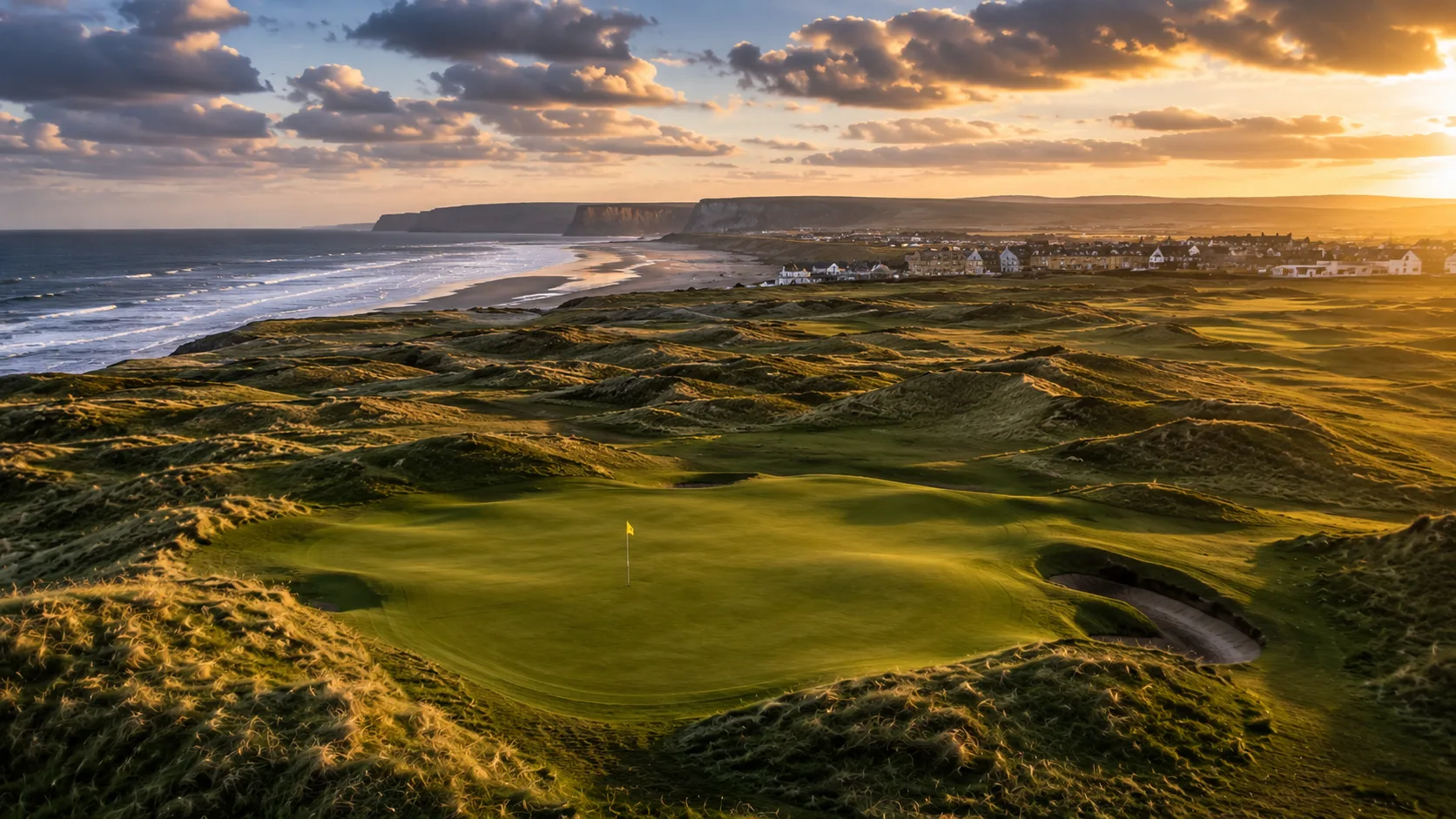
Old Tom Morris called Lahinch the finest natural links he’d ever seen when he laid it out in the 1890s. Two of his holes here — the blind “Klondyke” and “Dell” — are still played exactly as he left them, and a herd of free-roaming goats still forecasts the weather better than anyone in the clubhouse.
Venue-specific Lahinch Old Course photography from the TGG Media Library.
Course card
Championship scorecard
| Hole | 1 | 2 | 3 | 4 | 5 | 6 | 7 | 8 | 9 | OUT |
|---|---|---|---|---|---|---|---|---|---|---|
| Par | 4 | 5 | 4 | 5 | 3 | 4 | 4 | 3 | 4 | 36 |
| Yards | 381 | 534 | 446 | 475 | 154 | 424 | 411 | 166 | 400 | 3,391 |
| Hole | 10 | 11 | 12 | 13 | 14 | 15 | 16 | 17 | 18 | IN |
| Par | 4 | 3 | 5 | 4 | 4 | 4 | 3 | 4 | 5 | 36 |
| Yards | 441 | 170 | 577 | 279 | 461 | 466 | 195 | 436 | 534 | 3,559 |
Total: par 72, 6,950 yards from the blue tees.
Hole by hole
Eighteen holes, hole by hole
A workmanlike opener with no blind shots to ease golfers into the round.
A genuine three-shot par 5 that plays across open, rolling ground.
The hardest hole on the front nine (stroke index 4); the fairway narrows and briefly vanishes before reappearing near the green.
Old Tom Morris’s famous blind par 5: a 30-foot dune sits mid-fairway, and a flag-signal system tells the group behind when it’s safe to play blind over the top.
Completely blind from the tee, the green wedged between two steep dunes with only a white stone marking roughly where the pin sits.
The toughest hole on the course by stroke index — long, exposed and unforgiving of a loose tee shot.
A solid two-shotter that demands accuracy over raw length.
A shorter par 3 where the Atlantic wind usually decides the club.
Turns back toward the clubhouse to close the outward half.
A narrow, undulating fairway leads to a raised green guarded by four bunkers and dunes on three sides — the course’s third-hardest hole.
Played beside the beach with steep dunes and three bunkers collecting anything off-line; Alister MacKenzie designed an alternate green nearby for when the main surface needs rest.
The longest hole on the card, requiring three well-struck shots even in calm conditions.
A short, tempting par 4 — the easiest hole by stroke index, and a rare birdie chance.
A long, demanding two-shotter back into the prevailing wind.
One of the hardest closing-stretch holes on the course, requiring two accurate, committed shots.
A long par 3 to close out the short holes, exposed to whatever the Atlantic is doing.
A serious two-shotter setting up the finish, running alongside ground shaped by the Klondyke hill.
A par 5 finish in front of the clubhouse, giving a late chance to salvage or seal the card.
Why play
A links round with unmistakable personality
Lahinch is compelling because the course does not ask for one repeated type of shot. Natural contours, dramatic changes of direction and visually deceptive holes require golfers to interpret the ground and commit to decisions even when the landing area is not fully visible. The free-roaming goats that share the course are said to predict incoming weather more reliably than any forecast — head for the clubhouse if they do.
Its architectural lineage and Atlantic setting add context, but the strongest reason to play is the variety of decisions the course creates from tee to green.
Playing character
Trust the line and use the ground
Several shots can look more intimidating than the available landing area suggests. Commit to the chosen line, keep trajectory under control when the wind strengthens and allow firm turf to move the ball toward the target rather than insisting on an aerial approach.
Patience is important. Weather can alter the character of the course quickly, so a conservative target in one wind may become an attacking opportunity when the direction changes.
Who it suits
For golfers comfortable with uncertainty
Lahinch rewards players who enjoy reading conditions rather than executing golf by yardage alone. Mixed-handicap groups can enjoy it by choosing appropriate tees and treating the more unconventional holes as part of the experience rather than forcing a target score.
Stay · Play · Recover
Make County Clare part of the journey
Build Lahinch into a longer west-coast stay rather than rushing in and out for one round. Atlantic walking golf can be physically demanding, particularly in wind, so hydration, lower-leg mobility, good nutrition and sleep become practical parts of preparing for the next course.
Before you book
Check current visitor information
Visitor tee times, green fees, caddie availability, handicap requirements and seasonal restrictions can change. Confirm current arrangements directly with the club before travelling and check the Atlantic forecast close to the round.